
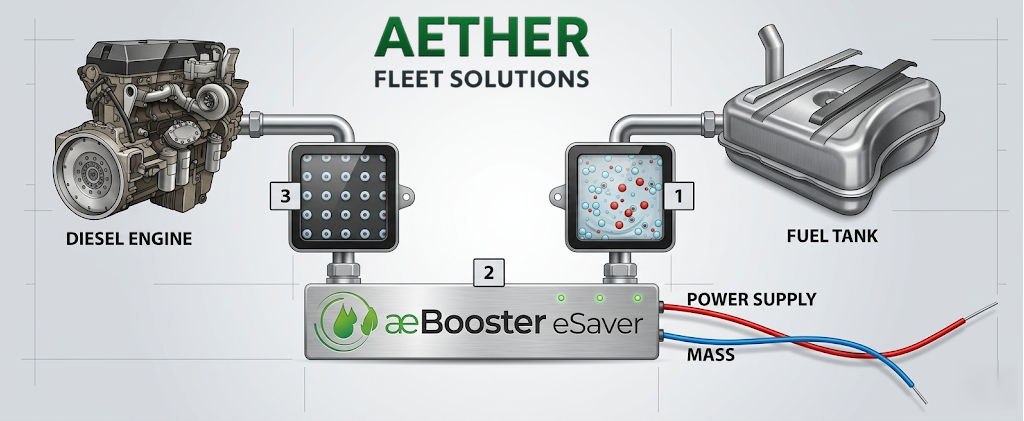
The aeBooster is an inline electronic fuel filter for diesel engines. It doesn't change the fuel you buy and it doesn't touch your ECU. It sits on the fuel line between the tank and the engine and acts on the diesel in the moments before injection — so it atomizes finer and burns more completely. Here is exactly how that works, and how it's installed.
Unlock the full step-by-step breakdown
See exactly how the aeBooster electronic fuel filter works, step by step — plus the specifications, the independent lab proof, and how it installs. Tell us a little about your fleet and we'll open the full breakdown.
In short
- It's an inline electronic fuel filter — fitted on the fuel line between the standard filter and the engine.
- It's an additional electronic stage on the fuel line that helps the diesel atomize into a finer mist for a more complete burn.
- Finer atomization burns more completely — less soot, lower consumption, cleaner exhaust.
- Passive and non-invasive — no ECU connection, no moving parts, warranty-safe.
The problem it solves: incomplete combustion
Diesel is a mix of hydrocarbon molecules that naturally cluster together. Under high thermal and mechanical load — exactly the conditions a working fleet runs in — those clustered chains don't fully break apart in the combustion chamber. The fuel on the inside of a cluster never gets enough oxygen contact to burn, so part of every injection leaves the engine as soot, heat, and unburned hydrocarbons instead of turning into motion. That wasted fuel is money out the tailpipe.
The lever, then, is combustion completeness: get more of each droplet exposed to oxygen, and more of the fuel you already paid for actually does work.
How the electronic fuel filter works, step by step
1. It installs inline, before the engine
The aeBooster is a sealed, passive device fitted on the fuel line between the fuel filter and the engine, as shown in the schematic above. It draws standard 12V or 24V power and ground — nothing else. There is no connection to the ECU, no sensor splicing, and no calibration change. Installation takes under three hours per unit and requires no change to driver behavior.
2. It applies a controlled electrostatic field
As diesel flows through the unit on its way to the injectors, the aeBooster applies a controlled electrostatic field to the fuel. That field acts on the polar bonds within the clustered hydrocarbon chains and reorganizes them — pulling the clusters apart so the fuel presents far more surface area to the incoming combustion air. This is the "filtering" action: it's not removing particles like a mechanical filter, it's electronically conditioning the fuel's structure so it's ready to burn cleanly.
3. The fuel atomizes finer
Better-organized fuel sprays into the cylinder as a finer mist. This isn't a marketing claim — it's measurable. In independent droplet analysis, treated fuel showed a smaller mean droplet diameter and a higher droplet count (more, smaller droplets). Smaller droplets mean more total fuel surface exposed to oxygen at the instant of combustion.
4. The burn is more complete
With more fuel surface meeting oxygen, more of each injection ignites and burns inside the cylinder rather than escaping as soot. The downstream effects are exactly what you'd expect from a more complete burn: lower fuel consumption for the same work, less particulate and soot, and lower combustion-related emissions.
What it is — and what it isn't
"Electronic fuel filter" is the accurate, plain-English description of the device: it sits in the fuel line and works on the fuel electronically before it burns. To be precise about what that does and doesn't mean:
- It does not replace your mechanical fuel filter. It's an additional electronic stage after it.
- It does not change the fuel you buy. Same diesel, same supplier — it changes how completely that fuel burns.
- It does not touch the ECU. No connection, no recalibration, no defeat-device behavior. It's EMC-certified to EN 50498:2010.
- It is not a chemical additive. The aeBooster is hardware; the chemistry side of the Aether stack is handled separately by the Duravi engine catalyst.
See the proof, then verify it on your fleet
Every claim here is backed by independent lab data — droplet analysis, engine-dyno results, and an EMC certificate — and a national-fleet field result. Then we re-establish it on your own telematics, to a 6% minimum, or you don't pay.
View the test data & evidenceHow it's proven
An electronic fuel filter only matters if the savings are real on real equipment. The aeBooster's mechanism is backed by independent engine-dynamometer testing (University of Zagreb, report LMV-2018-11-I-1), an EMC certificate confirming zero interference with vehicle electronics (Končar, EN 50498:2010), and droplet-atomization analysis. In the field, Croatian Post independently fitted the unit to its own delivery fleet and recorded an 18.9% fuel reduction over a 2,322 km trial on its own telematics, with the manufacturer not present.
Where it fits in the system
The aeBooster electronic fuel filter is one half of the Aether stack. It addresses incomplete combustion on the fuel side; the Duravi bio-based catalyst addresses mechanical friction on the metal side. Used together, they attack the two largest controllable costs on a fleet's P&L — fuel and maintenance — without touching the ECU, the warranty, or the driver's routine.
Run the numbers on your fleet
Model your savings with the calculator, or request a verification pilot — installed on a unit you choose, at our cost, measured on your data.
Model your fleet's savings